


How can the risk of deformation be reduced in an aluminum frame glass hinged door by matching the coefficient of thermal expansion?
Release Time : 2026-03-03
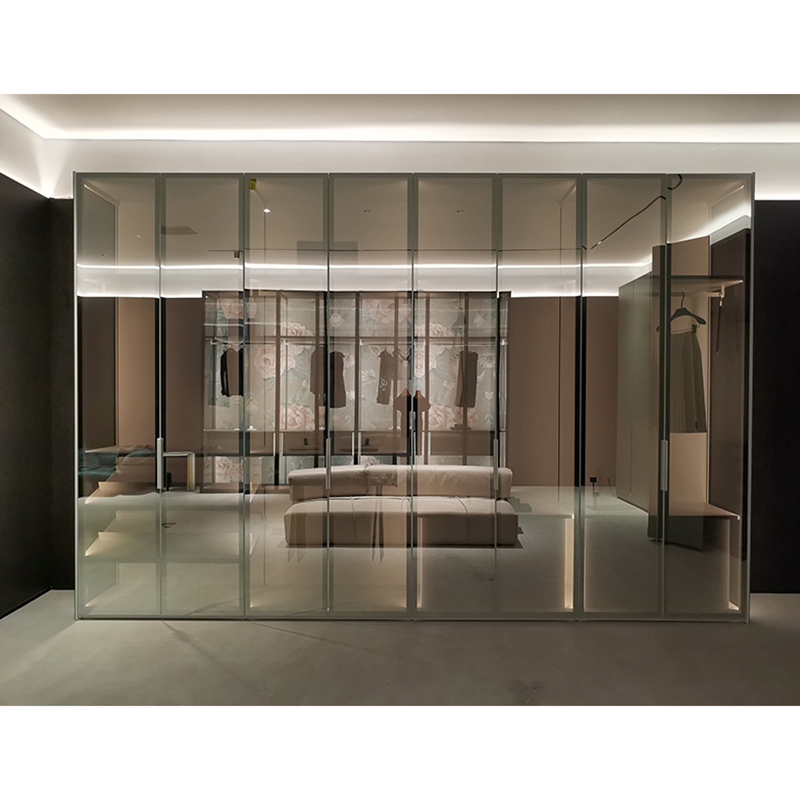
When aluminum frame glass hinged doors operate in environments with significant temperature variations, the difference in their coefficients of thermal expansion is a key factor leading to structural deformation, seal failure, and even glass breakage. The linear expansion coefficient of aluminum alloy is approximately twice that of steel, while that of glass is much lower. This difference means that as the door temperature rises, the expansion of the aluminum alloy frame is significantly greater than that of the glass. If not scientifically designed and matched, this can result in the glass edges being squeezed, uneven stress on the hinges, or excessive compression of the sealing strips. Conversely, as the temperature decreases, the aluminum alloy contracts more, potentially causing the glass to loosen, the door to not close properly, or seal failure. Therefore, precise matching of the coefficients of thermal expansion is crucial to reducing the risk of deformation.
Material selection is fundamental to matching the coefficients of thermal expansion. For the aluminum alloy frame, alloy types with coefficients of thermal expansion close to that of the glass should be prioritized. For example, adjusting the content of elements such as silicon and magnesium in the aluminum can reduce its coefficient of expansion, minimizing the difference with the glass. For the glass, tempered glass or laminated glass is a better choice due to its higher strength and ability to withstand greater thermal stress. Furthermore, auxiliary materials such as hinges and sealing strips must also be considered in the matching process. For example, the metal material of the hinges should have a similar coefficient of thermal expansion to the aluminum alloy frame to avoid excessively large or small gaps between the hinges and the door frame due to temperature changes. The sealing strips should be made of highly elastic silicone material; although its coefficient of thermal expansion is higher than that of glass and aluminum alloy, its elasticity can buffer some thermal stress and prevent seal failure.
Structural design is the core aspect of matching thermal expansion coefficients. The aluminum alloy frame needs to be structurally optimized to allow for expansion and contraction space. For example, gradient guide grooves can be set in the horizontal and vertical directions of the door frame to allow the frame to slide slightly in a predetermined direction when the temperature changes, avoiding localized stress concentration. The glass mounting position should use a floating pressure block design, that is, a small gap is maintained between the pressure block and the glass, connected by elastic gaskets, allowing the glass to move freely during thermal expansion and contraction, reducing edge stress. The hinge area needs to have a fine-tuning allowance, for example, by installing hinges through elongated or oblong holes, allowing the door leaf to adjust its position slightly during temperature changes, ensuring a tight closure. Furthermore, the connection between the door frame and the wall also needs to consider thermal expansion, for example, by using elastic connectors or reserving expansion joints to prevent the wall from restricting frame deformation.
Sealing design is a crucial complement to matching the coefficient of thermal expansion. Traditional sealing strips, due to their limited elasticity, are prone to excessive compression or tensile breakage under temperature changes, leading to seal failure. Modern designs often employ weather-resistant silicone sealants, whose high elasticity can accommodate the thermal expansion differences between aluminum alloy and glass while maintaining sealing performance. Furthermore, a dual-seal design can further enhance the effect: a low-elasticity sealing strip in the inner layer ensures daily sealing, while a high-elasticity sealing strip in the outer layer buffers thermal stress; both work together to extend the seal's lifespan.
Processing precision is essential for matching the coefficient of thermal expansion. The cutting, welding, and assembly of the aluminum alloy frame require strict tolerance control to ensure precise dimensions of each component and prevent uneven stress distribution during thermal expansion due to processing errors. Glass cutting and edge grinding must also meet high standards to prevent the propagation of micro-cracks under thermal stress. In addition, positioning fixtures must be used during assembly to ensure accurate relative positioning of the glass and frame, preventing uneven stress on the glass during thermal expansion due to installation deviations.
The installation environment is also a factor to consider in matching the coefficient of thermal expansion. Significant climate differences exist across regions; for example, northern regions experience cold winters and hot summers, while southern regions have smaller temperature differences but higher humidity. Design strategies must be adjusted based on the temperature range of the operating environment. For instance, in areas with large temperature differences, the difference in expansion coefficients between aluminum alloy and glass needs to be further reduced, or the proportion of elastic buffer structures should be increased. In areas with high humidity, corrosion-resistant sealing materials must be selected to prevent the combined effects of thermal expansion and corrosion.
Maintenance and inspection are crucial for long-term assurance of thermal expansion coefficient matching. During use, aluminum frame glass hinged doors require regular checks of the elasticity of the sealing strips, the tightness of the hinges, and the edge condition of the glass to promptly identify and address any loosening or deformation caused by thermal expansion. Furthermore, technologies such as infrared thermal imaging can be used to detect the stress distribution of the door body under temperature changes, providing a basis for design optimization. Through the synergistic effect of material selection, structural design, sealing design, processing precision, installation environment adaptation, and long-term maintenance, aluminum frame glass hinged doors can effectively reduce the risk of deformation caused by differences in thermal expansion coefficients, achieving long-term stable operation.