


How to choose the light transmittance of an aluminum frame glass wooden bathroom to balance privacy and lighting?
Release Time : 2026-04-29
In the design of an aluminum frame glass wooden bathroom, the choice of glass transmittance is a crucial element in balancing privacy and natural light. The aluminum frame, as a structural support, must balance strength and aesthetics; the wood elements enhance the warmth of the space through their natural texture, while the glass's transmittance directly impacts the user experience. If the transmittance is too high, activities inside the bathroom are easily observed from the outside, compromising privacy; if the transmittance is too low, the space becomes dark, requiring artificial lighting, increasing energy consumption, and lacking the comfort of natural light. Therefore, the type of glass and processing technology must be comprehensively selected based on the bathroom's functional zoning, user needs, and environmental characteristics.
While ordinary transparent glass has high transmittance, it offers relatively weak privacy, making it suitable for windowless bathrooms or scenarios with extremely high lighting requirements. This type of glass can achieve a transmittance of over 80%, maximizing the introduction of natural light and making small spaces appear bright and spacious. However, its completely transparent nature means the bathroom interior is completely visible, requiring additional measures to compensate for the privacy deficiency, such as adding curtains or blinds to the outside of the glass, or designing movable partitions on the wooden frame. While this combination solves the problem, it sacrifices some design simplicity, and the curtains are prone to dampness and mold, requiring regular maintenance.
Frosted glass, through a surface frosting treatment, effectively reduces light transmittance to 50%-70%, achieving a "light-transmitting but shadow-blocking" effect. Its principle is to use the tiny bumps and textures on the glass surface to scatter light, blurring the view while retaining some brightness. Frosted glass offers strong privacy protection, suitable for shower areas or homes with high privacy requirements. However, it is more difficult to clean; water stains and fingerprints easily form white spots on the frosted surface, requiring regular wiping with special cleaners or nano sponges. Furthermore, frosted glass has a relatively simple texture; for those seeking a more design-oriented look, a single-sided frosted finish can be chosen, with the frosted side facing inwards, protecting privacy while avoiding a monotonous external view.
Frosted glass, with its vertical striped embossed design, finds a more refined balance between privacy and light transmission. Its light transmittance is similar to frosted glass, but the striped structure further blurs the outline of a person, with an occlusion rate of approximately 85%. Simultaneously, it creates a soft grating effect through light refraction, adding an artistic atmosphere to the space. Fluted glass is particularly suitable for bathrooms with a light French or Scandinavian style; the vertical stripes can also visually elongate the ceiling height, alleviating the feeling of confinement in small spaces. It should be noted that ordinary fluted glass may have a greenish tint, affecting the quality of light transmission. Ultra-clear glass substrates should be chosen to avoid color deviation, although this will increase the cost by approximately 30%.
Smart dimming glass uses electronic control technology to freely switch between transparent and frosted states, providing a solution for a dynamic balance between privacy and lighting. The aluminum frame glass in the wooden bathroom has a built-in liquid crystal dimming film; it is transparent when powered on and becomes frosted when powered off. Users can adjust it at any time via a switch or mobile app. Smart dimming glass offers the strongest privacy protection and eliminates the need for additional curtains or blinds, keeping the space tidy. However, it is more expensive and requires a certain level of electrical design, making it suitable for users with a sufficient budget or those seeking a technologically advanced experience.
Frosted glass, through a special coating process, excels in privacy protection and stain resistance. Its surface is covered with a layer of matte micro-particles, with a light transmittance of less than 40%, making reflections completely invisible. The coating is also hydrophobic and oleophobic, allowing water stains and fingerprints to be wiped away easily, reducing cleaning frequency by 70%. Frosted glass has a high-end feel, suitable for upscale residences or hotel-style bathrooms, but it is expensive and has low light transmittance, requiring the use of a mirror light strip or auxiliary lighting to avoid a cramped feeling in a dark bathroom.
Low-E glass uses coating technology to reduce light reflection and improve light transmittance while blocking ultraviolet and infrared rays. The light transmittance of this type of glass can be customized to meet specific needs. High-transmittance glass can reach over 70%, suitable for bathrooms with poor lighting; medium-low transmittance glass reduces light transmittance by increasing the number of coating layers, suitable for scenarios with close building spacing or where privacy is paramount. Low-E glass also reduces indoor-outdoor heat exchange, improving bathroom insulation and reducing energy consumption for air conditioning or heating.
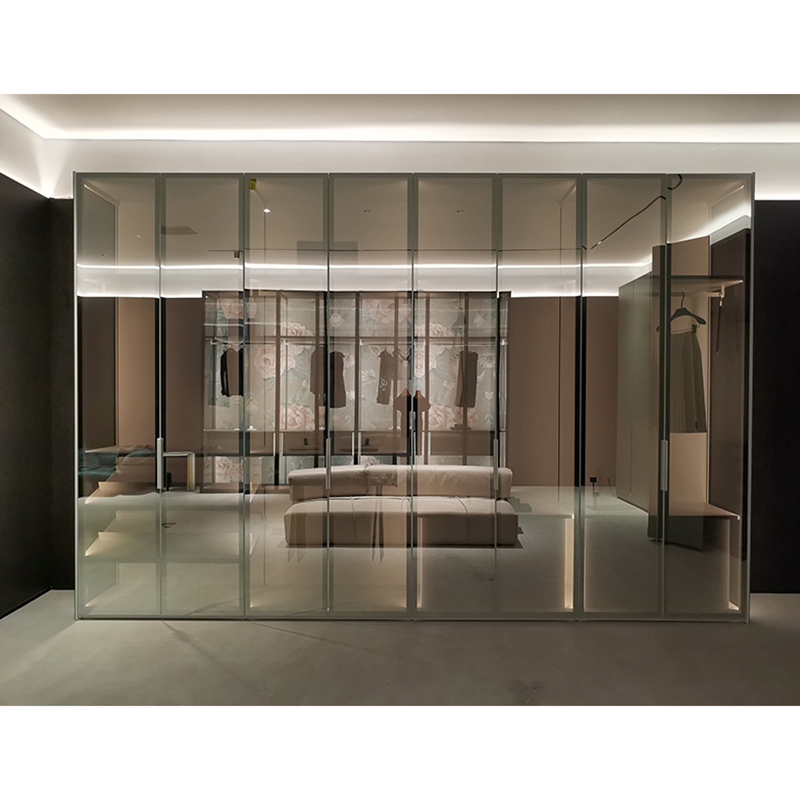
In practical selection, differentiated design based on the functional zoning of the bathroom is necessary. For example, frosted or fluted glass can be used in the shower area to protect privacy and prevent water splashing; ultra-clear glass can be used in the dry area to let in more natural light; if the bathroom is connected to the bedroom, smart dimming glass can be installed at the connection point to flexibly switch states according to usage scenarios. In addition, the width and color of the aluminum frame also affect the sense of space transparency; a thinner aluminum frame can reduce visual obstruction and enhance the continuity of the aluminum frame glass wooden bathroom; wooden elements can improve light reflectivity through light colors or natural textures, indirectly optimizing the lighting effect.